A Listening Walk for One Passing Sound
A listening walk for one passing sound turns an ordinary route into close listening, helping you notice how distance, shelter, and movement reshape it.
On a quiet street, a bicycle bell may ring once, then return as its rider moves between blocks. A listening walk for one passing sound gives that small change your attention: choose a sound that recurs, follow it with your ears, and notice how it shifts as you move. You do not need a special route or recording gear, just a place where you can walk safely and pause.
The point is not to identify every noise or reach a destination. Let one recurring sound serve as a thread through the walk. These eight choices make the exercise easy to adapt to a park path, a residential block, or a courtyard.
1. Choose a sound that returns without taking over
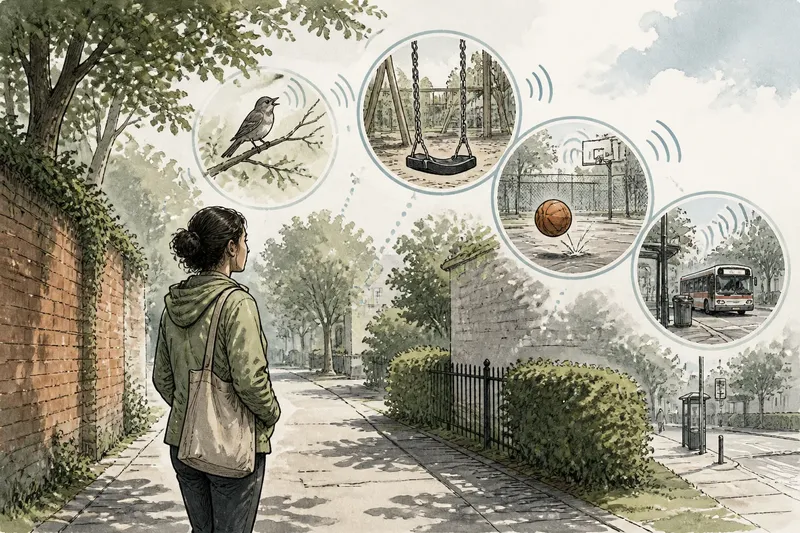
Listen for something that appears more than once but does not dominate the whole place: a bird call, a gate tapping in the breeze, a distant basketball bouncing, or a bus releasing air at a stop. A single isolated sound may be interesting, but a recurring one gives you a chance to hear differences between appearances.
Choose a sound that feels comfortable to attend to. If traffic, construction, or a loud crowd makes the route stressful, pick another location or another sound. There is no need to force concentration over an uncomfortable background.
Say you begin beside a courtyard and hear the soft squeak of a playground swing. If it returns while you walk along the outer path, you can compare each squeak with the previous one, rather than trying to catalog every sound around you.
2. Set a route that leaves room to listen
Pick a short route with a few different listening positions. A path that passes a wall, an open patch, and a stand of trees can offer useful contrasts without requiring a long outing. If you have a familiar loop, use it; knowing where the path bends lets you give more attention to the sound.
Choose sidewalks, public paths, or other places where walking and pausing are allowed. Keep your eyes on crossings and other hazards, and stop somewhere out of the way when you want to listen closely. Do not follow a sound into a private area or toward a road, work site, or other unsafe location.
Keep the route modest. A short stretch that allows an unhurried pause is more useful than a long route that turns listening into a race.
3. Hear the sound before naming its source
When the sound first returns, notice its shape before deciding what made it. Is it a short chirp or a sustained hum? Does it arrive in an even pulse, in a loose cluster, or as a single knock? Listen for qualities you can describe without guessing at the cause.
This distinction matters because a sound’s character can be clearer than its source. A distant rattle may come from a cart, a loose sign, or a passing vehicle; the walk does not need to settle that question. You can pay attention to the rattle’s roughness, rhythm, and apparent distance instead.
Try holding off on labels for the first few appearances. The sound may become easier to recognize once you have heard it from more than one position.
4. Notice what changes as you move
Walk at an ordinary, comfortable pace and listen for the sound again. As you move, it might seem louder, thinner, more muffled, or easier to place. Those impressions are useful observations, not proof that the source itself changed. Your position, nearby surfaces, and competing sounds can all affect what reaches your ears.
Pay attention to the relationship between your movement and the sound. Does it grow clearer when you approach an opening? Does it fade when a building comes between you and the source? Does it seem to shift from one side to another as you turn a corner?
Do not chase the source to make the change more dramatic. Let your route provide the listening positions, and note whatever is audible from each one.
5. Use shelter and open space as listening points
Pause where the route changes character: beside a brick wall, under a tree canopy, near a hedge, or in an open stretch. Listen for what happens to the recurring sound there. A wall may make a call seem more defined or may block it; leaves may soften a distant noise; open space may make a sound seem less contained.
Also notice whether the background changes. A bird call can seem prominent beside a quiet wall and nearly disappear near a busy intersection, even if the call itself is much the same. The surrounding soundscape is part of what you hear, not merely interference to ignore.
Choose one or two stopping places rather than pausing at every feature. That leaves enough quiet between comparisons for each impression to settle.
6. Compare two appearances without turning them into a test
When the sound returns, remember one clear quality from its earlier appearance. You might compare its rhythm, apparent distance, tone, or relation to the background. A simple mental note is enough: “closer and sharper,” or “same pulse, more distant.”
Imagine you hear a basketball bounce from an open path, then again from the other side of a row of trees. The second bounce may sound duller and less distinct. That gives you a useful observation about the sound from your new position; it does not require you to decide precisely where the player stands.
If the sound does not return, let that be part of the walk. You can keep listening to the place rather than searching for a replacement or inventing a comparison.
7. Keep the walk attentive and safe
Leave headphones off so you can hear your surroundings, and keep your phone in your pocket unless you need it for a practical reason. Do not close your eyes while moving or stop where others need to pass. At a crossing, attend to traffic and follow the usual signals instead of trying to maintain the exercise.
If someone nearby is making the sound, give them space and do not record or follow them. The exercise is about listening to the environment, not tracking a person. If you feel uncertain about a location, move to a familiar public path or end the walk.
For a useful listening walk, attention should never require you to ignore where you are.
8. What should you notice on a listening walk?
How do I choose a recurring sound?
Pick a sound that returns naturally and remains comfortable to hear, such as a bird call, a distant bell, or a gate moving in the breeze. If it is too loud, unsettling, or difficult to hear safely, choose another sound or place.
What if I cannot identify the source?
You can still follow qualities such as rhythm, pitch, texture, and apparent distance. Naming the source is optional; a careful description of what you hear is enough for this exercise.
Should I record the sound?
A recording is not necessary and may draw your attention away from the walk. If you do record, respect privacy, stay in a permitted public place, and avoid putting yourself in an unsafe position to capture a clearer sound.
How long should the walk last?
Continue while you can listen comfortably and move safely; there is no required duration. You can finish when the sound stops returning or when the route reaches a natural stopping point.
End by carrying one sound home
At the end of the route, take a moment to recall one change: the sound seemed nearer by the wall, broke into a quicker rhythm, or faded behind the trees. The detail does not need a technical explanation. It is enough to remember how moving through a place altered what you noticed.
A listening walk for one passing sound can fit into a familiar errand or a short break outdoors. Next time you take the same path, listen for whether that sound returns—and leave room for something else to catch your ear.